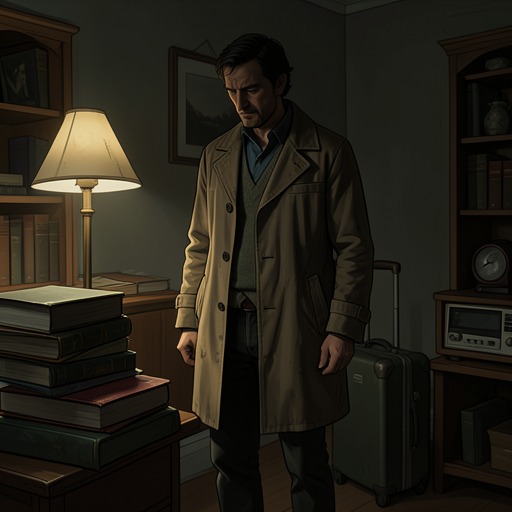
William Henry Devereaux Sr. and Mrs. Devereaux’s Marriage Broken by His Departure
Straight ManThe marriage of William Henry Devereaux, Sr. and Mrs. William Henry Devereaux is broken in practice but not in the way she understands it: after he leaves her for a graduate student, she continues to use his name and to think of herself as his wife. Their separation is therefore more than a private loss. It becomes a public identity, a source of family misunderstanding, and a wound whose consequences persist across generations.
The Departure and Its Aftermath
Both were professors at a respected Midwestern university when William Henry Devereaux, Sr. left for the East with his first new wife, a former graduate student. Mrs. William Henry Devereaux kept her university position and, in the narrator’s account, was never actually reduced to poverty. Rather than seek a larger divorce settlement, she chose to live far below her means, presenting her life as that of an abandoned woman. The narrator reads this austerity as a kind of theater aimed at humiliating her former husband, though he doubts that William Henry Devereaux, Sr. was much affected by the performance.
The appearance of deprivation outlasts the circumstances that might have justified it. Mrs. William Henry Devereaux continues teaching, lives in a shabby university house, and later moves to Railton after retiring. In old age she stays in Charles Purty’s flat. Her frugality thus belongs to the long aftermath of the marriage, not to an actual loss of professional standing or financial security.
A Marriage Preserved in Name
Mrs. William Henry Devereaux retains her former married name and explains that choice as protection against being mistaken for a feminist. The narrator understands a deeper attachment beneath that stated reason: she still considers herself William Henry Devereaux, Sr.’s wife, bound to him in her own conception of marriage despite the divorce papers. The distinction between legal separation and continuing self-identification is central to their relationship’s unresolved character.
That persistence creates an absurd public confusion. Readers of the Railton Mirror can take Mrs. William Henry Devereaux to be the narrator’s wife, and he is sometimes expected to defend her published opinions as if they were his spouse’s. Lily Devereaux, his actual wife, is also pressed to answer for views she does not hold. The old marriage therefore continues to make claims on the present: even its byline can blur the identities of the people who came after it.
Their Son Between Them
The narrator’s childhood memories show the household’s divided emotional climate. William Henry Devereaux, Sr. appears as an orderly early riser, already washed and dressed, reading in his study while his son sits on the floor with an encyclopedia. In retrospect, the narrator imagines that his father’s calm mornings might sometimes have followed encounters with graduate students, including the woman he eventually chose over Mrs. William Henry Devereaux. This is a son’s later speculation, not a reported confession from his father; as a boy, he mistook his father’s routine for uncomplicated virtue and his mother’s reluctance to face the day for a personal failing.
Mrs. William Henry Devereaux’s hurt enters the child’s daily life in smaller ways. On weekend mornings, he could spend hours quietly with his father and then ask his mother when breakfast would be ready. He suspects that this habit helped convince her he was his father’s son. The marriage’s rupture thus shaped not only how the parents regarded each other, but also how the mother interpreted her child’s resemblance and allegiance.
A more serious childhood memory brings the mother and son together around the marriage’s damage. After his father’s departure, the boy secretly tests a rope tied to a pipe in the cellar, trying to find out whether the pipe could bear his weight if life became unbearable. When his mother comes downstairs and sees him, he breaks into grief and goes into her arms. He cannot fully explain that he does not want his life to end; he wants reassurance that the pipe would hold if things worsened. She promises that the two of them will forget what happened. The memory binds them through care, but the adult narrator later recognizes the cost of that shared silence: he suggests that trying to forget the anguish also distanced mother and son from one another.
A Fear Carried Forward
The marriage’s unresolved presence becomes visible again in the narrator’s family. Julie Devereaux fears that her parents might divorce at a moment when she feels unable to bear another crisis. Her anxiety has been encouraged by her older sister Karen, who has long searched ordinary disagreements and misunderstood conversations for signs of an impending separation. Karen’s fear, shaped by the rancorous divorces among her high-school friends, passes to Julie; the daughters read the possibility of their parents’ divorce through the family history already surrounding them.
The marriage of William Henry Devereaux, Sr. and Mrs. William Henry Devereaux is therefore not simply a past event that ends with departure or divorce. Its meanings survive in a name kept, a life arranged around apparent abandonment, a son’s uncertain memories, and a daughter’s fear that her own parents may repeat the break. The novel presents that inheritance not as proof that the later marriage will fail, but as evidence that a separation can continue to shape a family long after its immediate circumstances have changed.